Dossier— who is this?
Research Highlightswhat I study
One question, asked three ways: how does designed interaction constitute the human?
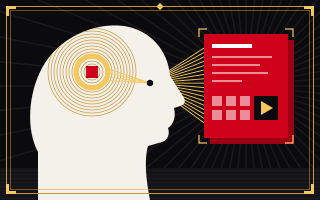
Philosophy of Interactionhow it ought to
How designed interaction ought to constitute the human — and what remains of personal agency after intervention. Treats reversibility as a neutral measuring dimension rather than a goal; argues cognitive tools should scaffold rather than substitute; and in education asks not whether AI may be used, but whether a given use still leaves the learner a seam they ought to cross themselves. Sits alongside AI philosophy's other live strands — mind (AI consciousness), technology (how AI changes the world), ethics (collaboration norms) — as its own addition: how AI forms the human.
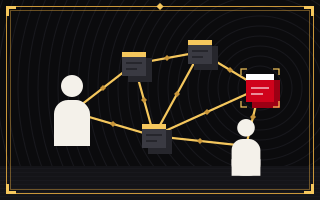
Sociology of Human–Agent Interactionhow it actually does
How AI reshapes social science's basic assumptions about interaction — and how humans and AI agents actually form social structure. Grounded in the published ASAF framework: agent identity design is not a UX convention but a collaboration interface — operating through identity signaling, behavioral priming, and collaborative governance — and becomes structurally necessary once a system scales beyond human working memory.

Psychology of Interactionwho is formed
How a particular person is formed in interaction — and stays the same person. Addresses the individual who is constituted, and could be substituted, by designed environments. The youngest of the three axes, with the least published output so far.
Summary
the short versionHow do we define the relationship between humans and emerging technologies? This has been the core question driving Meng-Han (Zaious) Lee's career — spanning iOS engineering, interaction design, VR, DeFi, and now multi-agent AI governance.
Working at the intersection of HCI, cognitive science, and multi-agent AI, that trajectory has grown into a three-axis research programme — philosophical, sociological, psychological — around a single question: how designed interaction constitutes the human. Its sociological axis is formalized in the Agentic Social Affordance Framework (ASAF), published in Frontiers in Computer Science.
His method is Research through Design: theory is drawn from firsthand experience designing, deploying, and operating multi-agent systems, then checked back against theoretical argument — not derived from theory first and applied second.
He does philosophy from inside the technical field — and argues that technology work needs people who can move between commercial decisions, technical architecture, and philosophical debate.
Product and client work — websites, tools, and custom AI systems — is published under his studio, ChronicleCore Studio (編年史記工作室).
Education
Experience
↓ timeline
- Built the product from the ground up as an early team member — architecture and engineering of a smart elderly-rehabilitation system: a multi-tenant platform serving five distinct user roles, currently in development
- Built and deployed demonstration prototypes for elder-facing and operator-facing experiences

- Take on independent consulting engagements spanning enterprise AI transformation planning, system architecture design, and AI applications in audio and video
- Delivered an AI-readiness and architecture audit for an overseas enterprise client: assessed an existing knowledge base for AI readiness, identified three architectural risks (semantic chunking that discards context, concept versions without temporal markers, and multimodal embeddings with no migration path), and specified a blueprint covering hierarchical chunking, temporal versioning, RAG metadata, and a deterministic rule engine. Delivered ahead of deadline with all milestones accepted

- Designed and operate a 39-agent multi-agent collaboration framework organized into five departments (Core / Shield / Hands / Soul / Senses)
- Implemented strict operational boundaries (RBAC/IAM) with Model Context Protocol (MCP) as standardized tool-calling interface
- Orchestrated complex R&D projects including real-time Azure Speech API integrations and autonomous domain-specific agent systems

- Technical intel router — spearheaded weekly GenAI tech syncs, synthesized emerging trends, and developed functional prototypes
- Led a comprehensive AI literacy framework for 1,000+ employees; featured speaker at Taiwan AI Academy (AIA) Forum
- AIGC implementation consulting for global brands (e.g., Carrefour AI Memory Codes)
- Lecturer in dentsu’s MOEA-approved SME digital-transformation training programme (2025)

- Founded PTT VR board (2016) during HTC Vive launch — promoting spatial computing in Taiwan
- Founded PTT AI_Art board (2022) — established thought leadership in Taiwan’s early generative AI art landscape
- Technology columnist on humanist impacts of emerging tech

- Developed government-tier iOS apps including New Taipei City Police App
- Published multiple independent iOS applications across a 4-year span